
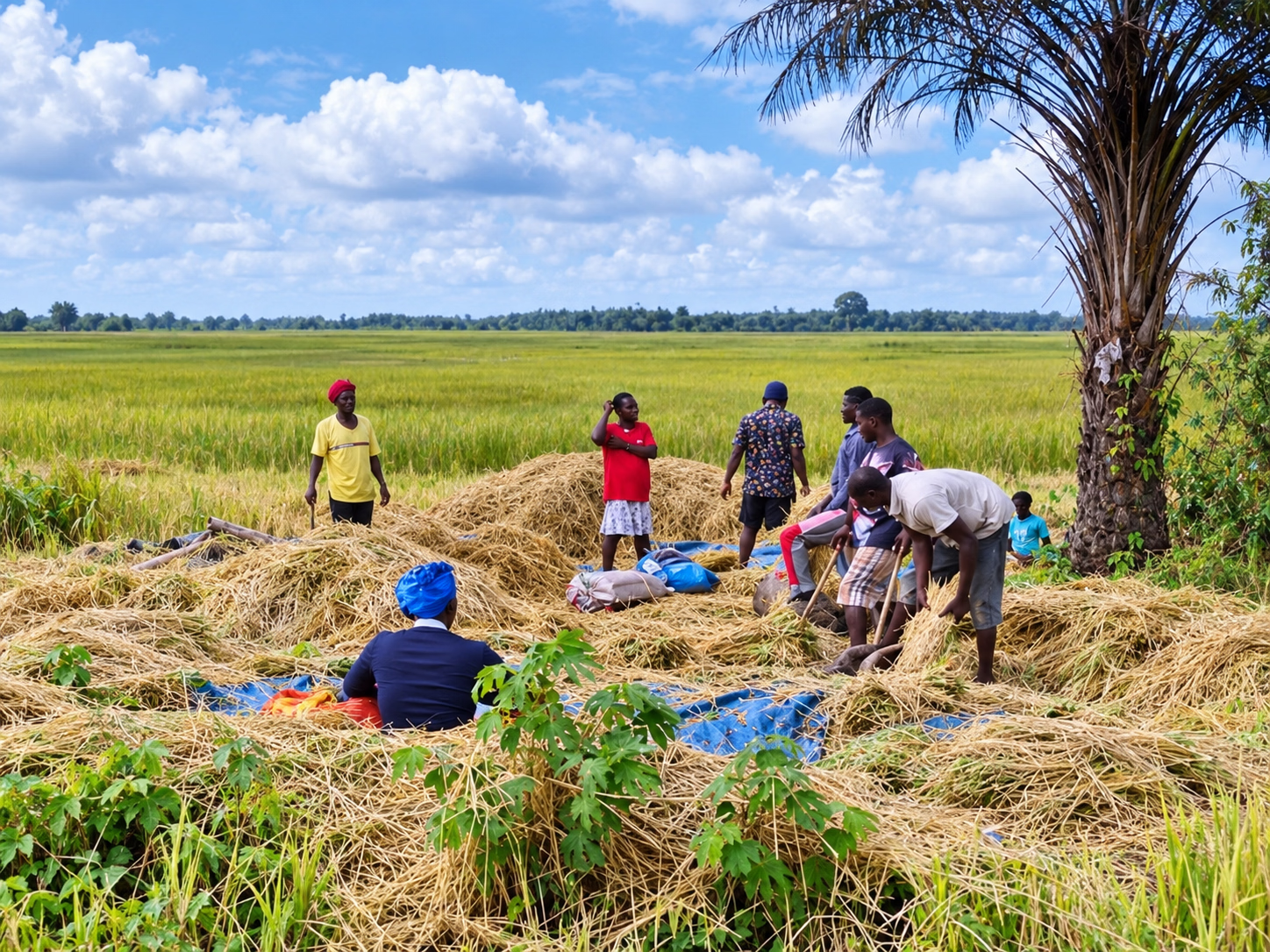
In a village in the Lokomasama chiefdom PORTLOKO district Sierra Leone, Green Is Life was fortunate to gain access to a piece of land. From the beginning, our goal was clear: we wanted to use this land not only for agriculture, but also as a place where we could demonstrate a more sustainable way of farming.
This year, we took an important first step by planting rice.
A first season full of challenges
Starting a rice farm is not easy, especially when you are doing it for the first time. During the season, we faced several challenges. Fuel costs were high, while tractors were necessary to prepare and work the land. We also discovered that our team was too small for the size of the farm.
Managing such a large area requires experience, enough people and good planning. These are all lessons we will take with us into the next growing season.


Despite these difficulties, we managed to complete the harvest. The total production was not yet as high as we would like compared to the time, energy and money invested, but for a first year the result gives us confidence.
Most importantly, we now have enough rice to make a better start next season. Part of the harvest can also be used as seed rice, giving other people in the community an opportunity to start growing rice themselves.
Agriculture and the environment belong together
For Green Is Life, agriculture is closely connected to environmental protection. Farming has a major impact on the soil, vegetation, wildlife and biodiversity. That is why we believe environmental education in Sierra Leone should also include sustainable agriculture.


One of the practices we want to change is the burning of farmland after harvesting. This remains common in many rural areas.
Burning vegetation may seem like an easy way to clear the land, but it also destroys valuable organic material. It can damage microorganisms in the soil and affects insects and other small organisms that are essential for healthy farmland.
Wildlife is also at risk. Birds and other animals live, feed and sometimes nest in agricultural areas. When fields are burned, their habitats can be damaged or completely destroyed.
Turning vegetation into compost
Our approach is different.
After this year’s rice harvest, we instructed the team not to burn the field. Instead, the remaining grasses and vegetation will be cut and collected. We want to use this material to create compost.
This compost can then be returned to the land.
In this way, material that would otherwise be burned becomes a natural source of nutrients for the soil. Over time, this can help improve soil fertility and reduce the need for other inputs.


The farm therefore becomes more than a place where rice is produced. It becomes a practical demonstration site where local farmers can see sustainable agriculture in action.
Trees, flowers and fruit trees
Our environmental work does not stop at agriculture.
We also want to encourage people in Sierra Leone to make their homes and communities greener by planting trees, flowers and creating gardens. But we believe that asking people to plant trees is not enough. We also need to help provide them with the resources to do so.
That is why we are working on a nursery for flowers, trees and fruit trees.
The aim is to grow enough plants so that, in the future, we can distribute them to people who want to make their homes and surroundings greener. In this way, environmental awareness can lead directly to practical action.
Learning, improving and growing
This first agricultural season has taught us a great deal. We experienced challenges, made mistakes and discovered where we need to improve.
But we also achieved something important: we planted rice, completed our first harvest and created a foundation for the next season.


Our ambition is not simply to produce rice. We want to show that agriculture and environmental protection can support each other. By avoiding burning, creating compost, improving soil quality and encouraging the planting of trees and flowers, we hope to build a model that others can follow.
This is only the beginning.
In the coming months, we will continue developing the farm, the composting system and our nursery. Through our website and social media channels, we will share updates so people can follow our progress, learn from our experiences and hopefully become part of a greener future for Sierra Leone.
Leave a Reply